Tally
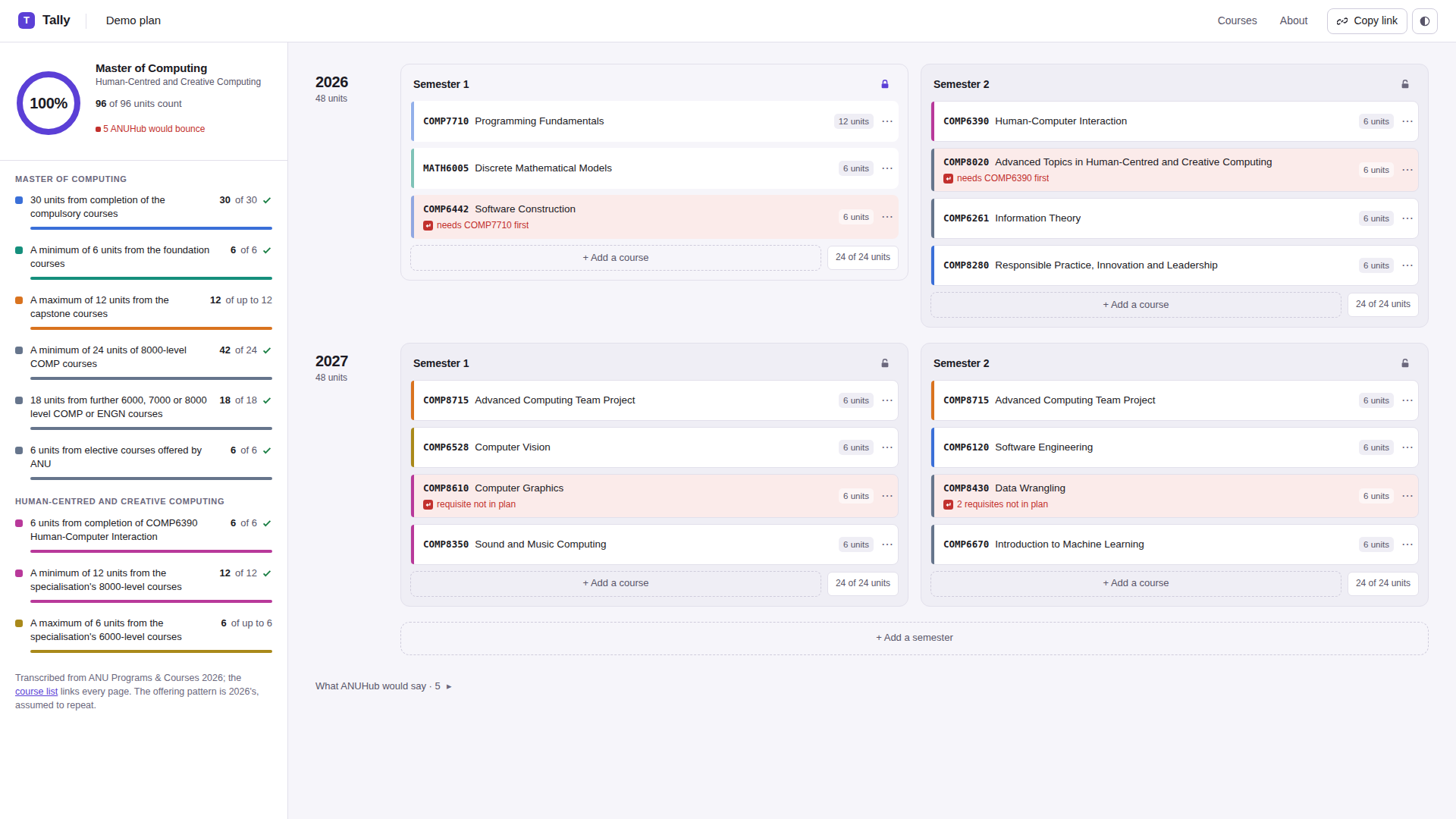
A study planner for the ANU Master of Computing. You put courses into semesters, and the page tells you, before enrolment day, what ANUHub (the system everyone still calls ISIS) would only tell you when you press enrol — which requisite isn’t met and why, what’s incompatible with what, which semester a course doesn’t run in, when a semester is over the full-time load — and it keeps a running tally of how far the plan is from the 96 units the program asks for, line by line, the way Programs & Courses states them. A plan lives at its URL, in SQLite on the machine’s volume, so it is still there after a reload, a restart and a redeploy; open the same URL on a phone and a laptop and they stay in step.
This is the slice of ANUHub I actually deal with. This semester I am taking COMP8020, whose requisite is a completed COMP6390, in the same semester as COMP6390 — the only way through is a permission code, and nothing in ANUHub shows you that until the moment it refuses you. The program’s requirements live on a different website, and checking a plan against them is done by hand.
What good looks like here
Good is knowing what ANUHub will say before it says it, and knowing whether the plan adds up to a degree. Two decisions follow from that.
The planner never refuses a real course. ANUHub refuses; this app records the placement and says what ANUHub would say and why — “needs COMP7710 completed first, but it is in the same semester” — because seeing the consequence is the point. The only refusals are bad data: a code not in the catalogue, a semester the plan doesn’t cover.
The data is a transcript, not an approximation. Every program line, course, requisite and offering was read from its 2026 Programs & Courses page, and the course list links each one. Where the page’s requisite has a shape the planner’s model can’t carry (COMP8600), the course says “not checked” rather than passing. Where the page is odd, the planner is odd with it: COMP8830 still asks for COMP8260, which COMP8280 replaced, so a Master of Computing plan can never satisfy that line as written — which is true.
Two assumptions are stated on the page: a course’s offering pattern is 2026’s and is assumed to repeat, and requisites about which program you are in are taken as met, because every plan here is a Master of Computing plan.
Every course card carries the colour of the requirement it counts towards — compulsory, foundation, capstone, the specialisation’s core or electives, electives — and a grey bar when nothing counts it, so a semester reads at a glance. A flagged card says a few words; the full sentence, in ANUHub’s terms, is one tap away, in the card’s drawer with the requisite line as Programs & Courses writes it, and in the list under the plan. Every control is a form first — the drawer, the search and the menus are what the script adds on top — so the plan still works with scripts off.
What is enforced, in spec/: a plan persists across a reload; a real course is
never refused; every rule (requisite order, the concurrent case, incompatibility,
offerings, load, each kind of requirement line) has a test that was seen red
first; the transcript’s shape and arithmetic; the live stream. What is a
judgement call: whether the flags read as a person would say them, whether the
tally is legible at a glance, and how the semesters stack on a phone — those were
settled in a real browser at both marking viewports, not by the tests.
What isn’t here
One program and one specialisation (Human-Centred and Creative Computing); the schema has room for more, the transcript doesn’t. No login: a plan’s URL is its only key. No tutorial slots, no Summer or Winter sessions, no permission-code workflow. COMP8715 can be placed twice, but the planner doesn’t check that the two semesters are consecutive.